Track the evolution of major financial and economic events
Bitcoin surpassed the $66,000 level on June 16, supported by improved risk appetite across financial markets. Easing geopolitical tensions following a US-Iran peace agreement contributed to the rebound in digital assets. Additionally, the market debut of SpaceX renewed enthusiasm for high-growth assets like Bitcoin.
Bybit has launched a dedicated options market for Tether Gold (XAUT), a cryptocurrency backed by physical gold, with contracts settled in USDT. These new options allow traders to hedge risks and speculate on gold prices within the crypto-commodity space. Meanwhile, Tether announced it is winding down its gold-backed derivative stablecoin, aUSDT, to shift focus toward products with higher market demand.
Marathon Digital Holdings purchased $66 million worth of Bitcoin to bolster its strategic treasury reserves. However, Matthew Sigel, VanEck's Head of Digital Assets Research, debunked speculations regarding the company purchasing additional BTC. Sigel noted that Marathon is unlikely to focus on further Bitcoin acquisitions as it pivots toward building its AI infrastructure.
Bitcoin reclaimed the $67,000 level following a mid-June dip toward $60,000, supported by on-chain data showing real buyers entering the market. However, analysts warn that the current options structure is positioned to amplify market volatility rather than stabilize prices. As of June 20, Bitcoin was trading at $64,159, with emerging trends showing traders accumulating long-term positions at a $120,000 strike price for December 2026 expirations.
XRP surged 10% on June 15 as the total cryptocurrency market capitalization approached $2.4 trillion, while Bitcoin held steady at $67,000. However, daily transactions on the XRP Ledger subsequently dropped to 1.74 million by June 18. By June 23, a major trader on the Hyperliquid platform faced the risk of a sudden liquidation of an XRP position worth over $30 million.
Bitcoin tested the $65,500 level as market sentiment improved following a diplomatic breakthrough between the U.S. and Iran that reopened the Strait of Hormuz. Falling oil prices and hopes for geopolitical de-escalation fueled the rally, leading to approximately $150 million in short position liquidations. With the price climbing above $65,000, expectations are growing for a potential return to the $69,000 mark in the short term.
Speculative short positions on the Japanese yen reached a nine-year high ahead of the Bank of Japan's policy meeting. There are growing concerns that Japanese monetary tightening could trigger an unwind of carry trades that support risk assets like Bitcoin. Consequently, the Bank of Japan raised interest rates to their highest level in 31 years, marking a significant policy shift away from near-zero levels.
Aztec Connect, a deprecated DeFi platform, was exploited on June 15, resulting in the theft of approximately $2.1 million in cryptocurrency. On June 16, a deprecated contract within the system was further exploited, leading to a total drain of approximately $2.19 million. The security breach occurred despite the platform having been inactive for years.
Bitcoin spot ETFs recorded $316 million in outflows, marking a fifth consecutive week of decline as institutional interest shifts toward altcoins like XRP and HYPE. Meanwhile, Franklin Templeton has proposed a new fund combining U.S. equities with a strategy to accumulate Bitcoin using stock dividends. Bitcoin is expected to face a choppy summer as institutional capital rotates further toward AI stocks and new technology IPOs.
Bitcoin reached a two-week high above $65,500 on June 15 as geopolitical premiums began to fade. The surge followed a peace agreement to reopen the Strait of Hormuz, which removed the geopolitical risk premium from oil prices. This shift boosted investor appetite for risk assets, leading to the significant recovery in Bitcoin's value.
Ethereum initiated a fresh increase on June 15, maintaining stability above the $1,680 level. Bulls are currently attempting to break through key resistance levels to sustain the momentum. The price may continue its upward trend if it successfully clears the $1,750 resistance mark.
Bitcoin surged past $64,000 following Donald Trump's remarks regarding a potential diplomatic deal with Iran that could reopen the Strait of Hormuz, despite disputes over the timing. However, the market remains under pressure due to Trump's warnings of potential military strikes and ongoing geopolitical tensions. Meanwhile, MicroStrategy Chairman Michael Saylor hinted at a new Bitcoin acquisition, fueling speculation as reports suggest growing momentum in U.S.-Iran diplomatic efforts.
The Bitcoin network experienced a substantial downward adjustment in mining difficulty of nearly 10% on June 14. This drop, confirmed on June 15, marks the second-largest downward adjustment this year and the 11th largest in history. The significant decline highlights mounting economic pressures currently affecting the mining sector.
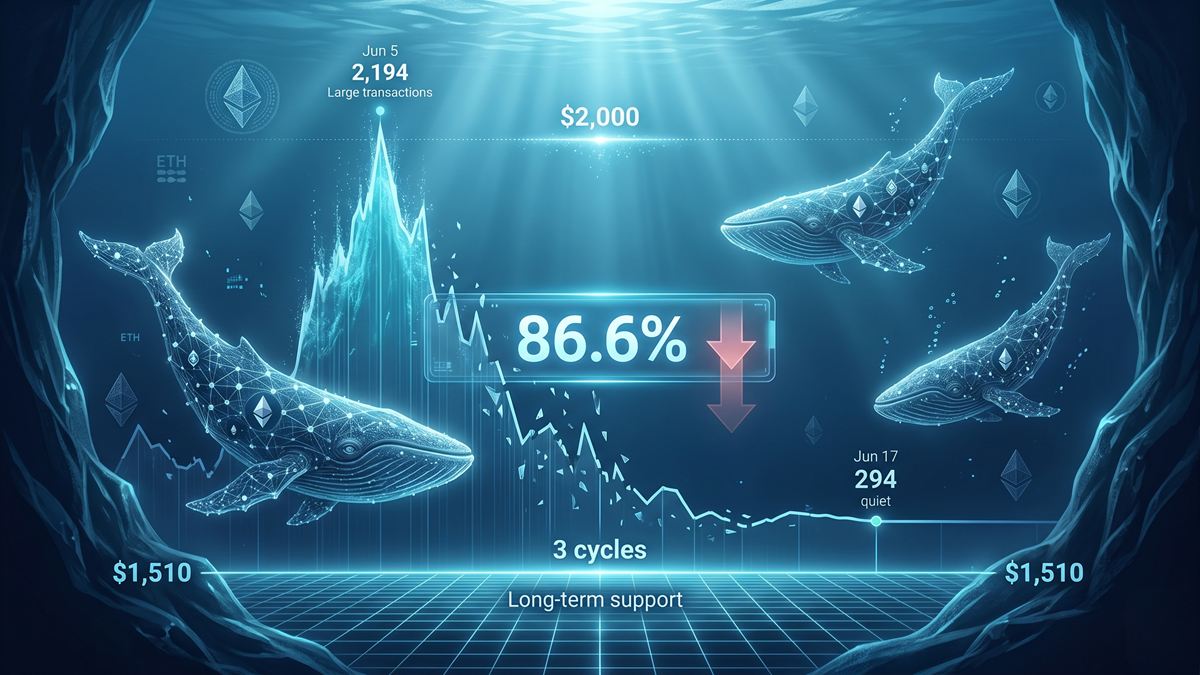
Large Ethereum holders accumulated approximately $800 million in ETH in mid-June, while a prominent trader realized $4.93 million in profit with a 90% win rate. However, by June 18, daily transaction volumes for large investors dropped sharply by 86.6%, marking the lowest institutional activity of the month. Technical indicators currently identify a historical support zone for the ETH price at $1,510.
Standard Chartered has declared the end of the 'crypto winter,' noting that the recent Bitcoin price correction likely marks the market bottom. The bank projects Bitcoin to exceed $100,000 and Ethereum to surpass $4,000 by the end of 2026. Additionally, the bank expressed a preference for Asia ex-Japan equities, specifically in Taiwan and China, supported by strong earnings prospects and AI-driven investments.
On-chain data indicates that the Bitcoin bear market bottom has not yet formed, based on the gap between long-term and short-term holders observed on June 13. By June 17, long-term holders reached a milestone, controlling a record 79% of the circulating Bitcoin supply. These metrics suggest that while accumulation is high, the cyclical floor remains unconfirmed.
Strive CEO Matt Cole has committed to an aggressive Bitcoin acquisition strategy to strengthen the company's treasury. On June 18, Capital B shareholders approved a significant share issuance and a credit facility specifically designated for Bitcoin purchases. Strive aims to leverage credit markets to attract $200 billion in new capital to the Bitcoin ecosystem.
The EU has granted regulators the authority to ban entire countries from digital asset markets and proposed banning transactions with 11 crypto platforms as part of sanctions against Russia. In response, Russia introduced new fees on USDT and USDC stablecoin transactions. Additionally, the EU set a deadline of July 1, 2026, for the expiration of temporary operating permissions for crypto companies without a full MiCA license.
The US House of Representatives is facing a significant divide among lawmakers regarding the urgency and necessity of advancing new digital asset tax legislation. Recent hearings highlighted conflicting perspectives on tax policy, while Representative Max Miller advocated for clear, technology-neutral rules to maintain US leadership in the sector. Additionally, a new bill was introduced to improve federal coordination for crypto hacks and victim support, reflecting a complex legislative landscape for digital assets.
Kraken has expanded its institutional infrastructure by enabling deposits and withdrawals for USDCx on the Canton network. The exchange also launched 'BTC Vault' for Bitcoin rewards and introduced cryptocurrency perpetual futures trading in the U.S. via Kraken Pro. These developments follow the company's May acquisition of Bitnomial, a fully CFTC-licensed exchange and clearinghouse.
Bitcoin miners are facing increasing economic strain as key metrics approach the stress zone, with the Puell Multiple falling to 0.74 and the Price-to-Miner-Revenue Multiple dropping significantly. While market prices have remained below average production expenses for five consecutive months, current data suggests gradual pressure rather than the widespread shutdowns seen in previous bear markets. To mitigate these conditions, the Bitcoin network is scheduled to reduce mining difficulty by 10.3% in its upcoming adjustment.
Hyperscale Data announced that its Bitcoin holdings reached 713.5884 BTC, valued at approximately $46.9 million as of June 14, 2026. This increase supports the company's strategy to integrate AI data centers with crypto, as it enters advanced negotiations to provide 20 megawatts of AI compute capacity in Michigan. The potential agreement is estimated to be worth between $1.0 billion and $2.5 billion. Additionally, the company reported $40.2 million in cash and restricted cash, alongside 10,000 ounces of silver.
Coinbase launched a high-yield USDC lending vault within its DeFi offering, utilizing Morpho infrastructure and curated allocations from Steakhouse Financial. The company also expanded its utility by launching a travel portal for One Card holders, offering 5% back in Bitcoin on bookings. Furthermore, Coinbase Ventures invested in Multipli, a real-world asset and tokenized credit protocol, through the Base Ecosystem Fund.
U.S. spot Bitcoin ETFs are facing a significant cooling in institutional interest, with BlackRock's IBIT leading the recent outflows. Concurrently, BlackRock is preparing to debut BITA, a new ETF designed to generate yield from Bitcoin exposure through options-based strategies. These developments highlight a shifting landscape in institutional investment approaches to digital assets.