
Taiwan Raises Short-Selling Margin to 150% as South Korea Prepares 10.76 Trillion Won Stabilization Fund
Key Facts
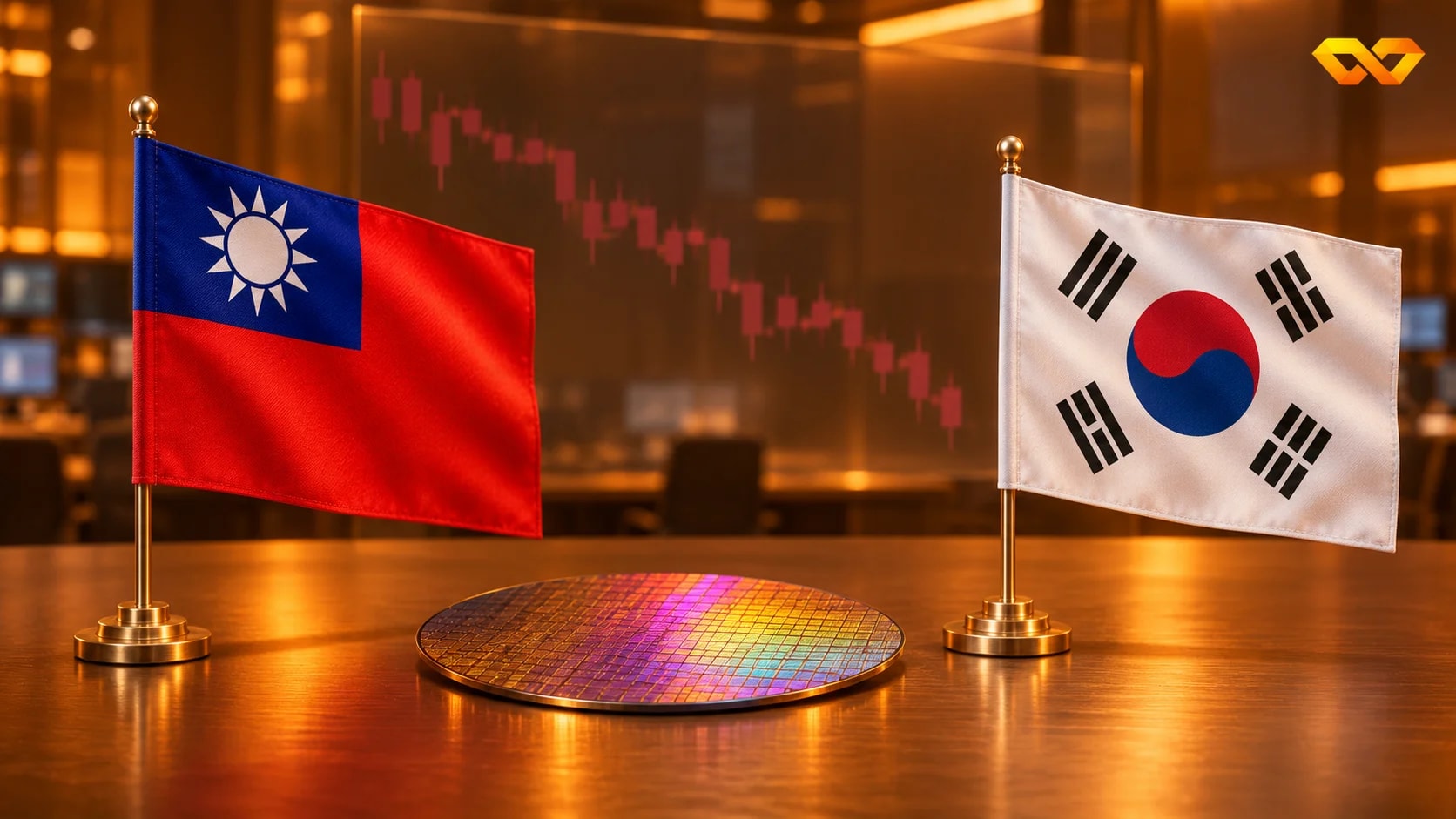
Taiwan raised the minimum short-selling margin from 130% to 150% effective November 23, while South Korea said it was preparing its stock market stabilization fund for immediate activation if market conditions required it. The measures reflect different responses to pressure on Asian markets following a global sell-off, with a clear focus on technology and chip stocks. South Korea’s Ministry of Finance said the fund totals 10.76 trillion won and could be financed through contributions from financial institutions if needed. But a Reuters report published via Fidelity did not say a decision had been made to inject funds into the market. In Taiwan, the higher margin took effect on Monday after the measure was announced on November 21.
Taiwan expanded its restrictions after previously banning short selling in stocks that had fallen 3.5% or more in the previous session, according to Taiwan’s Central News Agency. The agency said the broader ban was the first of its kind since 2015. Alongside the higher margin, the regulator suspended acceptance of applications to place sell orders and encouraged listed companies to buy back their shares. It also asked lenders to suspend securities lending or recall outstanding loans. The steps aim to restrict selling and borrowing tools in Taiwan’s market amid the sharp decline in stocks.
The move followed a 6.23% drop in the Taiex on Friday, November 20, closing at 36,033.29 points, its lowest close in about seven months, according to Taiwan’s news agency. In the week ending that day, Taiwanese stocks lost 17%, their biggest weekly decline since 1990, according to Reuters. South Korea’s index also fell to a 10-month low during the same week. Earlier, Japan’s Nikkei and South Korea’s Kospi indexes fell more than 5% in overnight trading on November 20, according to the Associated Press. In the United States, the Nasdaq Composite lost 5.3% on Friday, putting it in negative territory for the year.
In South Korea, the government also agreed to temporarily ease the daily limit on listed companies’ share buybacks for three months. According to a Reuters report, the fund can be activated immediately depending on market conditions, leaving the actual decision to use it open. Rather than impose short-selling restrictions, the authorities chose to step up monitoring of illegal selling for three months, according to SBS. Officials said short-selling restrictions were not among the measures, pointing to the importance of preserving international credibility and stable rules. Seoul thus moved to prepare support and buyback tools and monitor enforcement of the rules, while Taiwan imposed direct trading restrictions.
The concerns cited by Reuters center on whether heavy spending, financed mostly through borrowing, to build data centers for running artificial intelligence models can generate enough returns to repay lenders and justify stock valuations. The issue is especially significant in Taiwan and South Korea, where equity markets are linked to the chip sector, according to the reports’ account of the sell-off. The Philadelphia Semiconductor Index fell 10% on Friday, a decline Reuters cited as a source of further pressure on chip-dependent Asian markets. South Korean President Lee Jae-myung had called on November 13 for a review of ways to make the fund more effective, including its appropriate size and updated operating methods. That places a review of the fund’s mechanism in the context of South Korea’s preparations to intervene, without implying a decision to use it.
Taiwan’s moves reflect a backdrop of foreign selling pressure and market volatility. Taiwan’s Ministry of Finance said net foreign investor sales reached a record monthly level of 994.316 billion �� New Taiwan dollars in October, and net selling continued, reaching 524.4 billion New Taiwan dollars through November 6. In the week before that date, Taiwan’s market fell 12.19%, compared with a 15.7% decline in the Philadelphia Semiconductor Index, according to the ministry. The National Financial Stabilization Fund also said it had authorized its executive secretary to use its resources according to conditions after an extraordinary meeting on November 6. The fund cited a cumulative 5,510-point decline in the Taiex between November 2 and 6, and said the index closed on November 6, 20.55% below its high for the year.
Near-term dates investors may follow include the Bank of Korea’s consumer survey on November 24, followed by its business survey and economic sentiment indexes on November 25. In Taiwan, local elections are scheduled for November 28, including elections for mayors and local officials, according to the Associated Press. The agency said the results could offer an indication of the ruling party’s popularity ahead of the presidential election scheduled for 2028. Whether South Korea activates its stabilization fund remains tied to market conditions, according to the available report on the government’s preparations. Those dates provide near-term context for monitoring markets, while individual stock figures in the draft are not included here because they could not be verified against a reliable source among the evidence.