
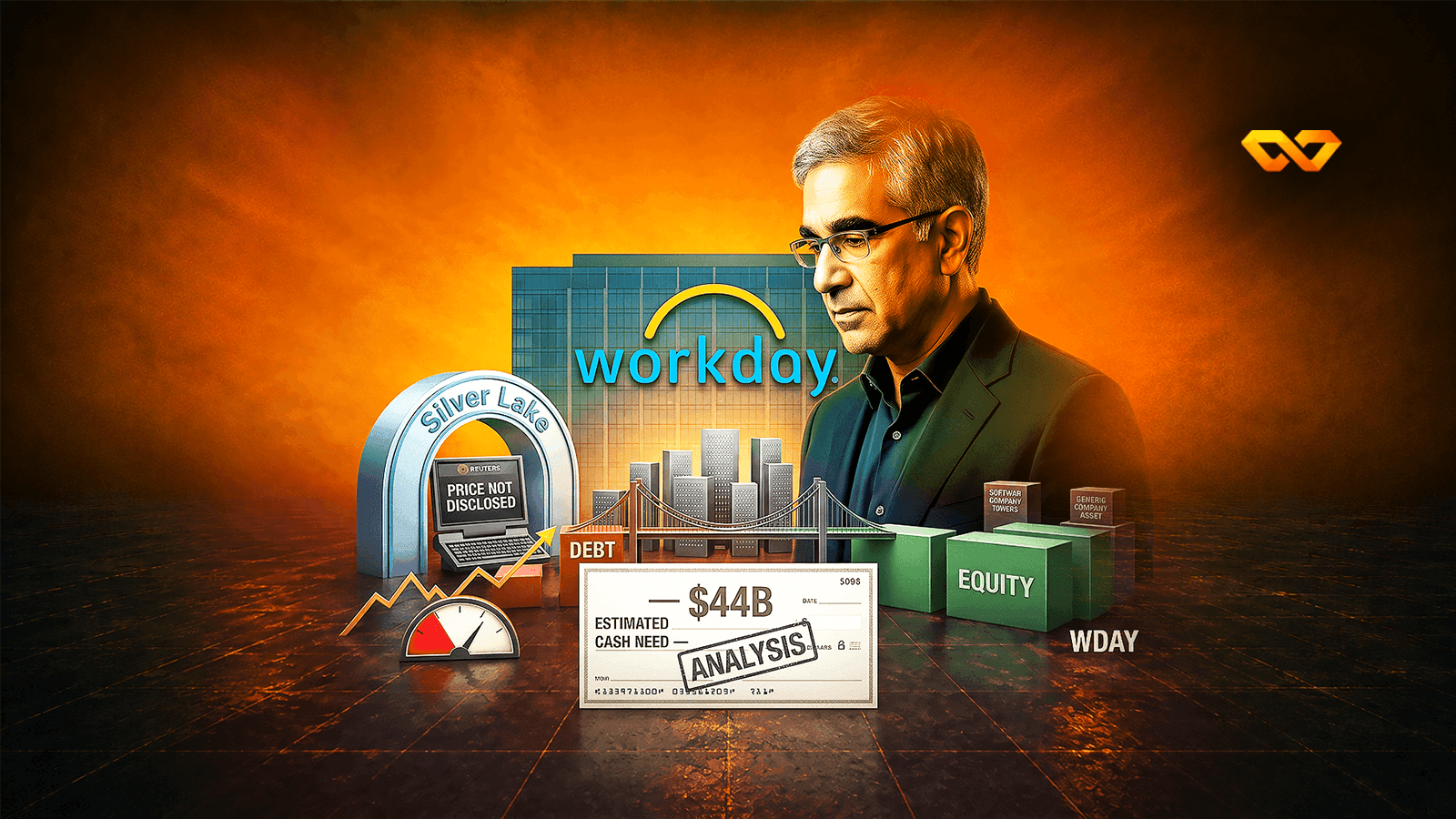
Reuters did not publish a price. The figure repeated by platforms is the market capitalisation before the news leak. This research measures the true price, explains why it cannot be debt-financed, then tests the entire sector using the same logic.
On 13 August 2026, Reuters reported that private equity firm Silver Lake was in talks to acquire Workday. Platforms repeated the figure “43 billion dollars” as the transaction value.
The figure is neither transaction value, nor an offer, nor a price. It is Workday’s market capitalisation before the news leak. Reuters did not publish a price at all.
| Item | Value | Source |
|---|---|---|
| Shares outstanding | 247 million shares | 10-Q cover, 20 May 2026 |
| Undisturbed closing price (12 August) | 175.29 dollars | Price data |
| Undisturbed market capitalisation | 43.30 billion dollars | 247 × 175.29 |
| 13 August close | 210.19 dollars (19.9%+) | External sources |
| Likely transaction value range | 54 – 57 billion dollars ~ | Derived from two measured premiums |
| Available debt capacity | 10.2 billion dollars ~ | Actual Electronic Arts transaction leverage |
| Debt share of financing | 18% – 19% ~ | |
| Required equity cheque | 44 – 47 billion dollars (81% – 82%) ~ |
The conclusion in three sentences. This transaction cannot be a leveraged buyout (Leveraged Buyout — LBO) in the conventional sense, because Workday’s operating earnings cannot support the required debt: its stock-based compensation (Stock-Based Compensation — SBC) is 2.26 times its operating income. Accordingly, around 81% of the price must come in cash from equity, a scale available only from sovereign capital, namely state money managed by sovereign investment funds. This is precisely what Gulf funds have been doing in this sector since the start of the year. When we ran US software companies through a screening tool based on the same acquisition logic, six names generated more cash than Workday for every dollar of market capitalisation — and when we excluded stock-based compensation, Workday fell to last place.
The largest question in the story remains unanswered: the company’s two founders have made no statement, and they control 69% of voting power.

Software companies listed on US exchanges • data as at 13 August 2026
This part of the paper is open to EL7 Pro members and to free members who use one of this month's free papers on it. The paper goes on to analyse the numbers, the causes and what they mean for investors, with tables, charts and sources.
This part of the paper is open to EL7 Pro members and to free members who use one of this month's free papers on it. The paper goes on to analyse the numbers, the causes and what they mean for investors, with tables, charts and sources.
This part of the paper is open to EL7 Pro members and to free members who use one of this month's free papers on it. The paper goes on to analyse the numbers, the causes and what they mean for investors, with tables, charts and sources.
A free account gives you 4 full research papers every month. Or subscribe to EL7 Pro for full access to more than 300 papers.
$700 per year · or $99 per month