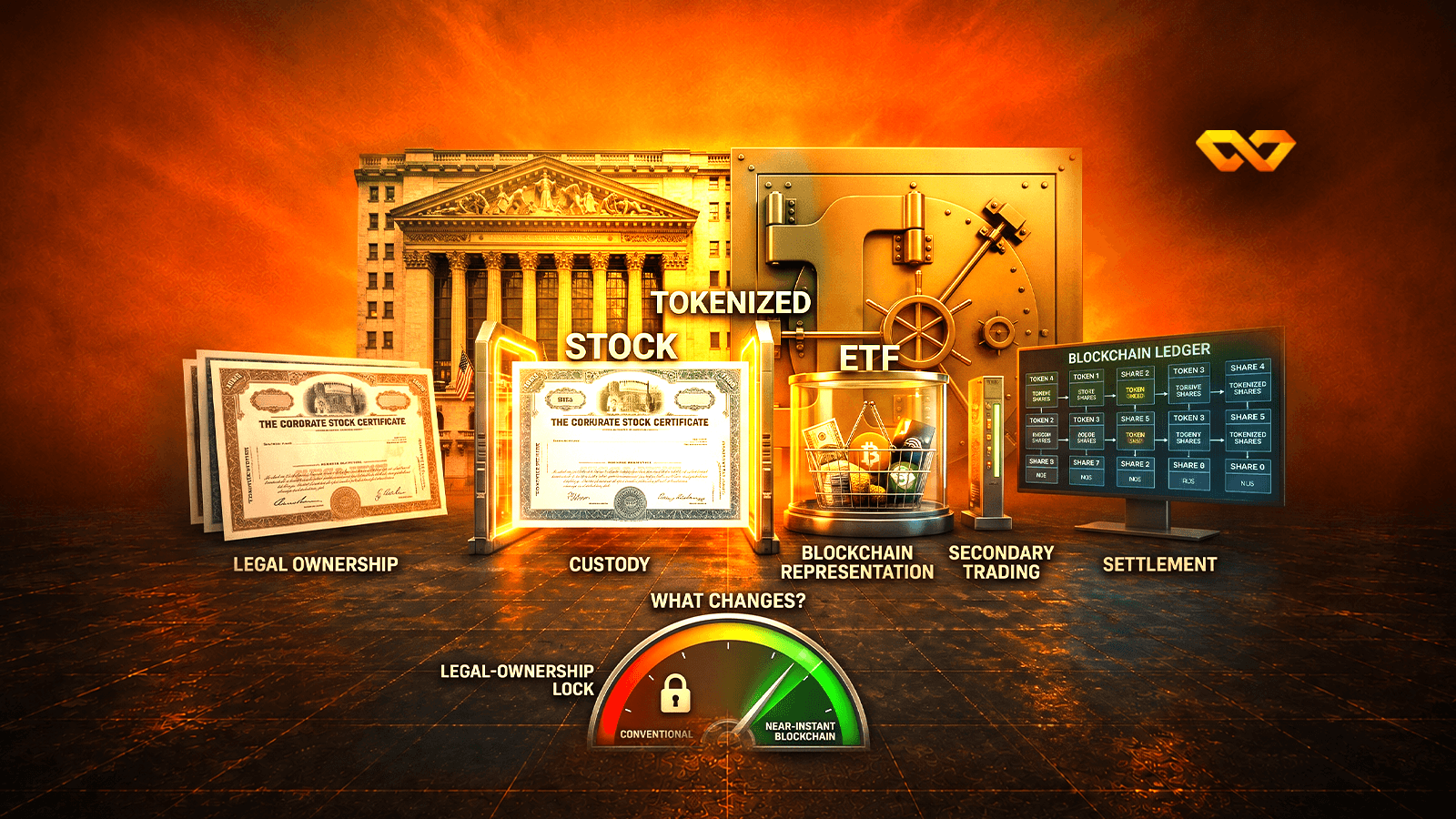
Stock Tokenization: Is It Really "The Next Big Thing After ETFs"?
Deep Dive · Stock Tokenization · July 17, 2026
A tokenized stock turns a traditional share into a digital token on a blockchain that trades 24/7, in fractions, across borders. The idea swept the market in 2025 — Kraken, Bybit, OKX, Robinhood — then the giants moved in: BlackRock, J.P. Morgan, Nasdaq, NYSE and DTCC. But behind the hype sits one question that governs everything: when you buy a "tokenized Apple share"… what do you actually own? This is the full report — what it is, how it works, who funds it, what institutions forecast, and how it's used for hedging.
Live tokenized-stock market: ~$1.85B2030 forecasts: $2T – $30TEL7 newsroom coverage: 600+ storiesAvailable in 100+ countries — excluding US persons
A tokenized stock is a digital token backed 1:1 by a real share held with a regulated custodian — giving you economic exposure to price and dividends. In today's dominant model (xStocks) it gives you no legal ownership and no voting rights — but a new SEC-aligned generation (Ondo's model, July 2026) has begun to grant real entitlements and votes. The trend is real and the infrastructure is genuinely being built (DTCC, Nasdaq, BlackRock) — but today it's a 24/7 global-access and hedging tool more than a full substitute for ownership.
EL7's read: "The next step after the ETF" is accurate in form (widening access) but premature in scale: the tokenized-stock market is still ~$1.85B. The real engine isn't speculators — it's institutions and settlement rails, a shift our newsroom tracked across 600+ stories in five months.
Live market (RWA.xyz)
$1.85B
+15% in 30 days
2030 forecasts (range)
$2T–$30T
McKinsey → Standard Chartered
Total RWA market today
~$32B
~10x in under 2 years (a16z)
EL7 newsroom coverage
600+
stories in 5 months (Feb–Jul)
xStocks launch
2025
Jun 30 — Kraken/Bybit/Solana
Securitize (round led by BlackRock)
$47M
later went public
BUIDL — BlackRock
2
value locked on public chains
Geo-blocked
US
+ UK / Canada / Australia
Part One
The Concept & the Mechanics
01
What is a tokenized stock? — A precise definition
A tokenized stock is a digital token on a blockchain that tracks the price of a real share (Apple, Tesla, the SPY ETF). But not all "tokenized stocks" are the same; there are three fundamentally different models, and conflating them is the source of most confusion:
◆ (a) Fully-backed 1:1 via a custodian
The most widespread model (xStocks by Backed Finance, and Robinhood). The issuer buys the real share, holds it with a regulated bank, then mints one token per share.
You hold economic exposure via a tracker certificate — not the share itself.
◆ (b) Synthetic / derivative
A token that mirrors the price via derivatives or collateral without a real share behind it.
Higher counterparty risk, and excluded from "asset-backed" market metrics.
◆ (c) Natively-issued, SEC-compliant
Issued via an SEC-registered transfer agent, granting real rights (voting/distributions). Example: Ondo's new model and Franklin's BENJI.
This is the track that fixes "you don't own the share" — detailed in §07.
◆ Bottom line: what do you own?
In today's dominant xStocks model: no ownership, no voting rights, no legal claim.
Legally a "bearer debt instrument" (a tracker certificate) — verbatim per Kraken's legal page and the xStocks docs.
"Holders of xStocks do not have ownership in any of the underlying stock or shares… have no voting rights, or distribution entitlements, or legal claims to the underlying stocks."— Kraken's official legal page for xStocks
02
How it works — from the real share to the token
In the fully-backed 1:1 model (xStocks), the mechanics are a five-step loop, built on Switzerland's DLT Act (Art. 973d):
01
Issuer buys the real share
02
Deposits it with a regulated custodian
03
Mints a 1:1 token on-chain
04
Proof-of-Reserve (Chainlink)
05
24/7 trading + cash redemption
Custody: the underlying shares sit with licensed custodians (Clearstream, InCore Bank, Maerki Baumann, Alpaca) in segregated accounts under a three-party Account Control Agreement.
Chains: not Solana-only — tokens are issued natively across Ethereum, Solana, Arbitrum, Mantle, TON and Ink and other EVM networks (ERC-20 and SPL/Token-2022).
Dividends: passed through economically via rebasing or a USDC airdrop — a discretionary token feature, not a legal shareholder distribution.
Redemption: redeemable with the issuer for the asset's cash value (not the physical share), and for eligible investors only.
Key verification point: the "1:1" backing is the issuer's assertion, supported by Chainlink Proof-of-Reserve — but an independent report (BlockEden, Oct 2025) flagged the absence of published independent smart-contract audits and custodian transparency. And a16z (2026) notes only ~5% of tokenized bonds are actually used in DeFi — so "composability" is still more promise than reality.
03
Why is it called "the next step after the ETF"?
The ETF took a basket of stocks and made it trade like a single share — lowering the barrier for millions. Tokenization proponents argue it's the next step on the same logic: it takes the individual stock and makes it trade like a crypto token — with properties neither the ETF nor the traditional share can offer:
Feature comparison — traditional share vs ETF vs tokenized stock
Feature
Traditional share
ETF
Tokenized stock
Trading hours
Market hours
Market hours
24/7 (on-chain)
Fractionalization
Limited
Partial
Down to tiny fractions
Settlement
T+1 / T+2
T+1 / T+2
Near-instant (T+0)
Global access
Via local broker
Via local broker
Wallet + internet
DeFi composability
No
No
Yes — collateral/lending
Legal ownership
Yes — full
Yes — via the fund
Model-dependent (No in xStocks / Yes in SEC model)
Note the last row: tokenization's biggest advantage (flexibility) used to come at the cost of ownership — but that is exactly what the SEC-aligned models are now trying to fix.
Part Two
The Events & the Institutions
04
The timeline — how tokenization became the market's talking point
Apr 2021Franklin Templeton launches BENJI — the first US-registered fund to use a public blockchain (Stellar) to record ownership.
May 2024BlackRock leads a $47M round in tokenization firm Securitize and picks it as transfer agent for BUIDL.
Jun 17, 2025Coinbase reveals it is seeking SEC approval to offer tokenized equities to US users.
Jun 30, 2025Launch day: Backed Finance launches xStocks (60+ stocks) on Kraken, Bybit and Solana — and the same day Robinhood launches 200+ EU stock/ETF tokens and reveals its own Robinhood Chain L2.
Jul 2, 2025OpenAI disavows the "OpenAI tokens" Robinhood handed out: "These are not OpenAI equity."
Jul 9, 2025SEC Commissioner Hester Peirce: "Tokenized securities are still securities."
Jan 2026SEC issues a third-party custodial tokenization framework — the legal basis for compliant US models.
Mar 18, 2026SEC approves Nasdaq to issue, trade and settle tokenized stocks and ETFs.
Jul 1, 2026Ondo launches the first SEC-aligned tokenized-stock model (BlackRock's IVV + Micron) with real voting rights.
Jul 15, 2026DTCC moves tokenized securities into live trading (with JPMorgan, BlackRock, tokenized Microsoft shares) — a Wall Street milestone.
05
The Robinhood–OpenAI story — a lesson in "what you actually own"
At its Cannes event (June 2025) Robinhood handed out "OpenAI and SpaceX tokens" — exposure to private, unlisted companies via blockchain. The response came fast from OpenAI itself, and it exposed the core worry about tokenization:
"These 'OpenAI tokens' are not OpenAI equity. We did not partner with Robinhood, were not involved in this, and do not endorse it. Any transfer of OpenAI equity requires our approval — we did not approve any transfer."— OpenAI's statement on X, July 2, 2025
Robinhood CEO Vlad Tenev responded that the tokens — while not "technically" equity — give retail investors exposure via Robinhood's stake in a special purpose vehicle (SPV) holding OpenAI shares. The takeaway: even when there's a real asset behind the token, what you own is a claim on an intermediary issuer — not the share directly. That distinction is the axis of the entire regulatory risk.
06
Institutions build the rails — from experiment to infrastructure
The strongest signal of the trend's seriousness isn't token prices — it's who's building the rails behind it:
◆ BlackRock
The BUIDL fund passes $2B on public chains; it's a Securitize investor and Ondo partner.
Larry Fink: "tokenization can greatly expand the world of investable assets beyond the listed stocks and bonds that dominate markets today."
◆ Regulatory & settlement infrastructure
Nasdaq: SEC approval (Mar 2026). NYSE (ICE): platform for late 2026.
DTCC: pilot → live trading (Jul 2026). Swift: a tokenized-deposit settlement ledger with 17 banks.
◆ Franklin Templeton + J.P. Morgan
BENJI: a US government money-market fund on a public chain — $1.98B, $650M on Stellar.
Kinexys (J.P. Morgan): institutional tokenization + the JPMD deposit token on public chains.
◆ Coinbase + Securitize
Coinbase is seeking a no-action letter to offer tokenized equities to US users.
Securitize (BlackRock's infra) partnered with Cantor Fitzgerald for on-chain offerings, then went public.
"Ledgers haven't been this exciting since the invention of double-entry bookkeeping… but a bond is still a bond, even if it lives on a blockchain."— Larry Fink & Rob Goldstein (BlackRock), December 2025
07
The SEC-aligned US model — when the token becomes "real ownership"
The most important development addresses the "you don't own the share" critique head-on: on July 1, 2026, Ondo Finance launched the first SEC-aligned tokenized-stock model — tokens for BlackRock's IVV (S&P 500 ETF) and Micron shares on Ethereum, under the SEC's January 2026 third-party custodial framework.
✓ The crucial difference from xStocks
Tokens are issued by an SEC-registered transfer agent, Oasis Pro TA (which Ondo acquired), with Broadridge handling proxy voting and disclosures. The underlying shares stay in the traditional US custody chain, and the token holder receives "the same governance rights as investors who own the securities through traditional brokerage accounts — including voting." That is economic and legal ownership — the opposite of xStocks.
"Today's milestone shows we can tokenize securities in ways that meet both market and regulatory requirements, for U.S. and global investors."— Ian De Bode, CEO of Ondo Finance, July 1, 2026
Ondo now runs over $1 billion in tokenized securities across 430+ assets (outside the US for now, rolling out gradually). This opens the biggest question: when will US persons be let in? — the path Coinbase, Nasdaq and Injective (which also filed for SEC transfer-agent status, per our coverage) are all chasing.
08
From our newsroom — what the daily wire says
Tokenization isn't a theoretical topic for us: EL7's news platform tracked more than 600 stories on asset and stock tokenization in just five months (Feb–Jul 2026), 454 of them with the topic in the headline. The dominant story isn't speculation — it's infrastructure moving from "concept" to "live rails":
609
stories on asset/stock tokenization in our coverage514 in crypto · 84 in stocks · continuous from Feb 11 to today
A sample of our live coverage (Arabic feed). The key takeaway: the race has moved to the infrastructure layer — exchanges, clearing, chains — not just retail-traded tokens.
Part Three
The Numbers & the Money
09
Institutional forecasts — a small reality, a huge story
Keep today's reality and the forecast apart. The live tokenized-stock market is only ~$1.85B (RWA.xyz), but up ~15% in 30 days and ~4x over six months; the leaders are Ondo (~$851M, ~46%) then xStocks (~$482M, ~26%). The whole RWA market (ex-stablecoins) is ~$30–34B — up ~10x in under two years (a16z), led by Treasuries (~45%) then gold (~15%).
On the "big story," the houses disagree on the number but not the direction — each implies roughly 100x growth:
Tokenized-asset size forecasts — most conservative to most bullish
Institution
Forecast
Horizon
Note
McKinsey
< $2T
2030
most conservative (range $1–4T)
Bernstein
$5T
2028
nearer horizon
Citi (base case)
$5.5T
2030
equities largest line ~$3.6T
BCG / Ripple
$9.4T
2030
→ $18.9T by 2033
ARK (Cathie Wood)
$11T
2030
from ~$19B today
Standard Chartered
$30T
2034
highest — widest scope
Fig 1
Institutional forecasts for total tokenized assets ($ trillion)
$2T
McKinsey
$5.5T
Citi (base)
$9.4T
BCG/Ripple
$11T
ARK
$30T
Std Chartered
The range runs from ~$2T (McKinsey, most conservative · 2030) to ~$30T (Standard Chartered, widest scope · 2034) — the disagreement is about definition (are deposits and stablecoins counted?), not whether the trend is real. Citi's base case of $5.5T sits in the middle.
10
Who's funding the wave? — follow the money
To gauge how serious a trend is, follow the capital going into it. The big players are all present:
◆ Ondo Finance (the leader)
Raised ~$46M; the $20M Series A was co-led by Founders Fund (Peter Thiel) and Pantera.
Backers: Coinbase Ventures, Tiger Global, Wintermute, GoldenTree, 1kx. Largest holder of BUIDL (~$223M).
◆ Securitize (BlackRock's infra)
$47M round led by BlackRock (2024) + Hamilton Lane, ParaFi, Tradeweb.
A BlackRock exec joined the board; it went public (Jul 2026), and ARK took a stake.
◆ Backed Finance (xStocks issuer)
A $9.5M Series A led by Gnosis (2024) + Exor Seeds, Cyber Fund and others.
The Swiss firm behind the AAPLx/TSLAx tokens listed on the exchanges.
◆ Public-market bets
Alpaca (tokenized-stock infra) raised $135M (led by Peak XV).
ARK plays the theme via Coinbase (COIN), Circle (CRCL), Robinhood (HOOD).
The common thread = BlackRock: investor in Securitize, partner to Ondo, owner of the largest tokenized fund (BUIDL). When the world's biggest asset manager builds on these rails, the question becomes "when," not "if."
Part Four
Use-Cases & the Verdict
11
Hedging & practical use-cases — and their honest limits
If you're a trader, what do tokenized stocks actually add? Four real use-cases — each with a limit worth understanding:
◆ Off-hours gap hedging
When the US market is closed (weekend/overnight) and big news hits, the token lets you adjust exposure 24/7 instead of waiting for the open.
Limit: off-hours liquidity is thin, and the token price can decouple from the stock (basis risk).
◆ Collateral without selling
Post the tokenized stock as collateral to borrow a stablecoin in DeFi — liquidity without closing the position or a taxable event.
Limit: only ~5% of tokenized assets are used in DeFi today (a16z) — capability exists, adoption doesn't.
◆ Global access & currency hedging
A non-US investor builds US-equity exposure to diversify local-market/currency risk without a foreign broker.
Limit: blocked for US persons and some countries; check your jurisdiction.
◆ Fractional building & rebalancing
Build a basket in tiny amounts and rebalance instantly — useful for small or automated portfolios.
Limit: on-chain fees/slippage can eat the edge at very small sizes.
Use-case verdict: tokenized stocks are a tool for access, flexibility and short-term hedging — not a long-term vehicle that replaces legal ownership (except in the SEC-aligned models). Treat them as a tactical instrument with real limits, not a full substitute.
12
The debate — why caution is still warranted
▲ The bull case
24/7 global access: a US stock in a wallet from any country, with open hours.
Liquidity, fractions and near-instant settlement.
Composability: collateral/lending in DeFi — impossible with a traditional share.
Real institutions: Nasdaq, DTCC, BlackRock, J.P. Morgan building the rails.
▼ The skeptic's case
You don't own the share (in xStocks): exposure via an issuer, no votes.
Counterparty & custody: you depend on issuer/custodian solvency (Peirce's warning).
"Zero audits": the 1:1 backing isn't independently audited yet (BlockEden).
Fragmented + off-hours liquidity: price can decouple when the exchange is closed.
"As powerful as blockchain technology is, it does not have magical abilities to transform the nature of the underlying asset. Tokenized securities are still securities… market participants must adhere to the federal securities laws."— Hester Peirce, SEC Commissioner, July 9, 2025
Why are US persons blocked? Most tokenized stocks (xStocks) are unregistered under the 1933 Act (offered under Regulation S, outside the US) and convey no legal ownership — so they're geo-blocked from US, UK, Canadian and Australian persons. Access is open in 100+ countries. (The SEC-aligned models are the path to opening the US market later.)
13
OKX & xStocks — how it trades in practice
OKX is among the leading venues that listed xStocks: 24/7 trading of tokenized US stocks and ETFs, settled in USDT, on both Solana and X Layer (OKX's own network). OKX integrated xStocks into its wallet from July 7, 2025, and available tokens include AAPLx (Apple), TSLAx (Tesla), NVDAx (Nvidia), SPYx (the S&P 500 ETF), plus GOOGLx, MSTRx and others.
The flow: complete KYC → convert to USDT → buy the stock token directly or via the wallet on-chain.
xStocks trading competition: OKX is currently running (mid-July 2026) a spot trading competition on xStocks/USDT pairs, with tiered rewards (new users / trading volume), requiring full KYC and excluding restricted jurisdictions.
Geo-restriction: you must confirm you are not a US person to access xStocks trading on OKX.
↗ Try it yourself — via EL7's link
OKX xStocks Spot Trading Competition
If you're outside the restricted jurisdictions and want to try trading tokenized stocks in practice, you can enter the OKX competition via EL7's link below — and watch how "Apple" or "Tesla" moves as an on-chain token around the clock.
Disclosure: the link above is an affiliate link for OKX and may earn EL7 a reward. Tokenized stocks are not available to US persons (or UK/Canada/Australia) and carry counterparty and liquidity risk. This is educational content, not investment advice — do your own research and follow your jurisdiction's rules.
14
What this means for an EL7 trader
✓ The opportunity
24/7 global access
A genuine tool for fast, fractional exposure and short-term hedging, with institutional momentum building the rails and a US model that grants real ownership.
✕ The limit
Know what you own
In xStocks it's exposure, not ownership; custody/audit risk, blocked for US persons, and volatile off-hours liquidity.
EL7's verdict: stock tokenization is a real trend, not a naming bubble — backed by names building the rails (BlackRock, DTCC, Nasdaq), and tracked across 600+ stories in our feed. But "the next step after the ETF" is a slogan that runs ahead of reality: the market is still ~$1.85B, and today the product is an exposure, hedging and liquidity tool more than a full substitute for ownership — except in the SEC-aligned models now closing that gap. Treat it as exactly that: a real opportunity, with a precise understanding of what you own — and what you don't.