
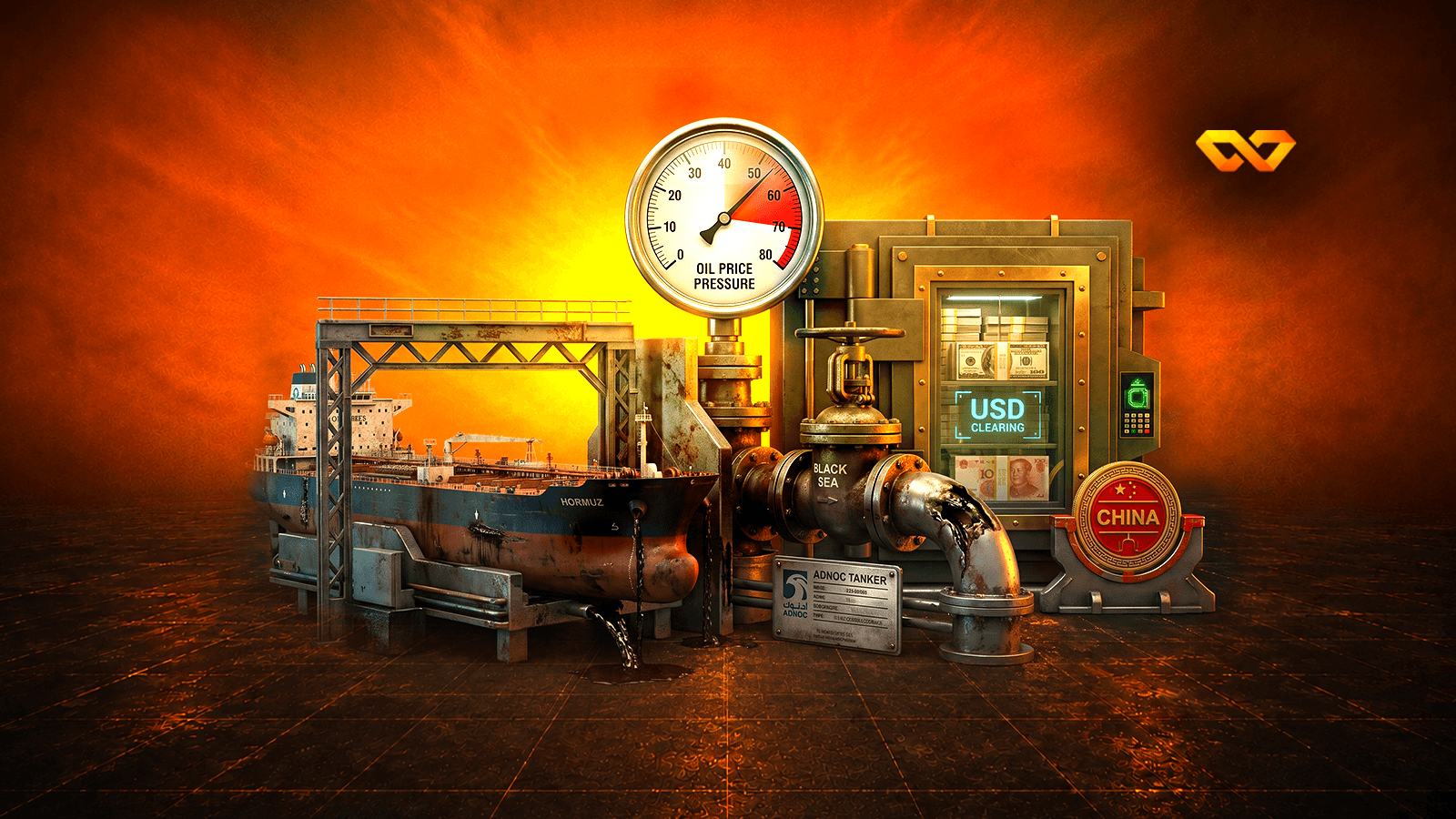
In four days, two physical valves of global oil supply were hit: the Strait of Hormuz and Russia’s Black Sea port. At the same time, Washington raised its hand over a third valve through which not a single barrel passes: the dollar clearing system through which Iranian oil sales to China are financed. This report tracks what happened at each valve, what the price did, and who held positions as it unfolded.
Brent crude ended publication week on Friday 14 August at 88.52$, then continued rising for a full week to close on Friday 21 August at 94.39$ (+6.63% above its publication level), while West Texas Intermediate, WTI, closed at 87.06$ (+5.66%) — according to the EL7 database. This leaves Brent up 55.1% since the start of 2026, but still 18.6% below its year-to-date closing peak of 115.89$ recorded on 8 March — meaning the market is still pricing “persistent disruption”, not “a full blockade”, although the gap between the two has narrowed.
What rebuilt the risk premium this week was three valves, not one: the first — on Thursday evening, 13 August, drones attacked two UAE ADNOC tankers inside the Strait of Hormuz; Abu Dhabi formally accused Iran and described the attack as “acts of piracy”. The second — the Sheskharis terminal at Russia’s Black Sea port of Novorossiysk suspended crude loading on Friday after a major Ukrainian drone attack on the night of 11–12 August; the terminal normally ships around 700 thousand barrels a day. The third — US Treasury Secretary Scott Bessent said Washington would unveil “a combination of economic isolation the world has never seen” against Iran. Analysts expect the measures to target major Chinese banks for the first time, which finance the purchase of more than 90% of Iranian oil exports. By 21 August, the third valve had widened but remained unresolved: Washington moved to publicly threaten sanctions against buyers of Iranian crude in China, India and Turkey; Beijing publicly rejected the US demand, while independent Chinese refiners began cutting purchases of Iranian oil.
The Commitment of Traders (COT) report reveals a clear paradox. Managed Money had been reducing its long WTI positions throughout the two weeks preceding the escalation — from a peak net long of 92,943 contracts on 28 July to 79,916 contracts on 11 August (a snapshot preceding the Thursday attacks). The premium at publication therefore resulted from a repricing of physical risks, not speculative chasing — leaving room for a buying wave if escalation persisted.
And the wave arrived. In the 18 August report — the first snapshot following the Thursday attacks — Managed Money’s net long in WTI rose to 87,479 contracts, an increase of 7,563 contracts in one week, while the positioning index jumped from 85.5 to 91.0. This ended three consecutive weeks of reduction, and speculators joined the physical repricing rather than lagging it. The paradox identified by this report was therefore temporary, and closed in the following week.
This part of the paper is open to EL7 Pro members and to free members who use one of this month's free papers on it. The paper goes on to analyse the numbers, the causes and what they mean for investors, with tables, charts and sources.
This part of the paper is open to EL7 Pro members and to free members who use one of this month's free papers on it. The paper goes on to analyse the numbers, the causes and what they mean for investors, with tables, charts and sources.
This part of the paper is open to EL7 Pro members and to free members who use one of this month's free papers on it. The paper goes on to analyse the numbers, the causes and what they mean for investors, with tables, charts and sources.
A free account gives you 4 full research papers every month. Or subscribe to EL7 Pro for full access to more than 300 papers.
$700 per year · or $99 per month