
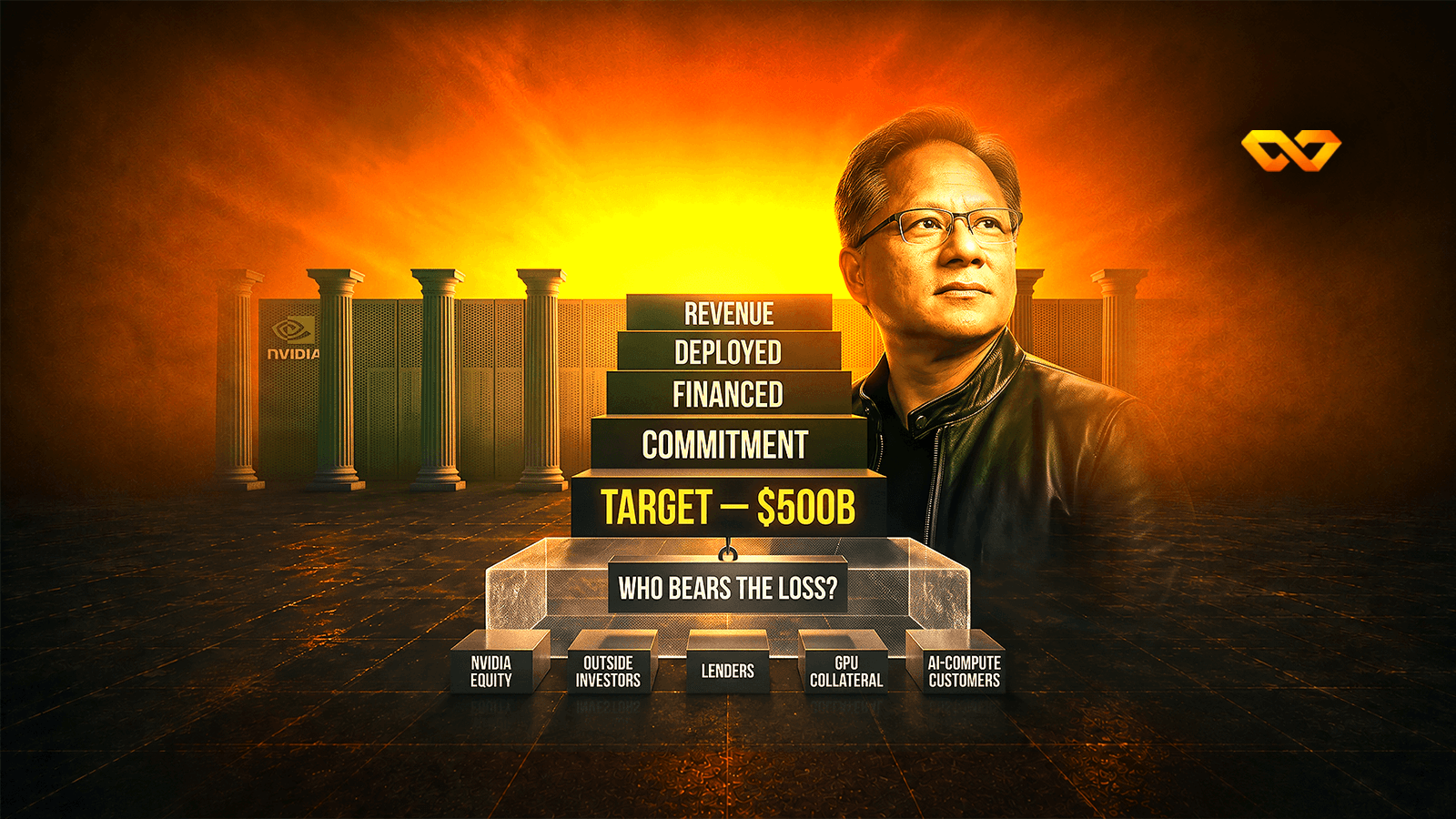
NVIDIA announced financing platforms with six major institutions. The figure is large, but it sits on the first rung of a five-rung ladder: target → commitment → funding → deployment → revenue. This research climbs the ladder rung by rung and asks the question the announcement does not answer: who bears the loss if the bet is wrong?
On 10 August 2026, NVIDIA signed Memoranda of Understanding (MOUs) — non-binding preliminary agreements preceding definitive contracts — with six major financial institutions: Apollo, BlackRock, Blackstone, Brookfield, Goldman Sachs and KKR, to create independent platforms targeting the mobilisation of more than $500 billion in third-party capital “over time”. The official text itself qualifies everything: the agreements “remain subject to the execution of definitive agreements”, and no maturities, pricing or stakes were published. The figure is therefore a design target on the first rung of a five-rung ladder — stated target, then commitment, funded capital, deployment in projects, then recognised revenue — and alone establishes no higher rung.
The most widely circulated idea — that NVIDIA “guaranteed” a quarter of the half-trillion — does not withstand scrutiny: the statement on residual-value support (Residual-Value Support) “up to 25%” appeared in press reports citing Jensen Huang, not in the official announcement text, and the same newspapers differ on the denominator for the percentage (the deal value? the gap? the project?). There is therefore no mathematical basis for the claim of a “$125 billion guarantee”. Nor did the market read the announcement as a celebration: NVIDIA shares lost around ~$130 billion in market value in the following session, as we noted in our research on the AI debt wave.
Verdict: the initiative is an attempt to redesign the compute-financing market — moving hardware from buyers’ balance sheets to specialist capital platforms — not a completed transfer of risk. The investment question shifts from “is there demand?” to four tests: utilisation, customer, tenor and residual value. The CoreWeave reference case shows that contractual visibility (98% of revenue under committed contracts) coexists with high customer concentration (the two largest customers ≈65%) and a debt maturity wall absorbing 46.6% of debt during 2026–2027.
This part of the paper is open to EL7 Pro members and to free members who use one of this month's free papers on it. The paper goes on to analyse the numbers, the causes and what they mean for investors, with tables, charts and sources.
This part of the paper is open to EL7 Pro members and to free members who use one of this month's free papers on it. The paper goes on to analyse the numbers, the causes and what they mean for investors, with tables, charts and sources.
This part of the paper is open to EL7 Pro members and to free members who use one of this month's free papers on it. The paper goes on to analyse the numbers, the causes and what they mean for investors, with tables, charts and sources.
A free account gives you 4 full research papers every month. Or subscribe to EL7 Pro for full access to more than 300 papers.
$700 per year · or $99 per month