
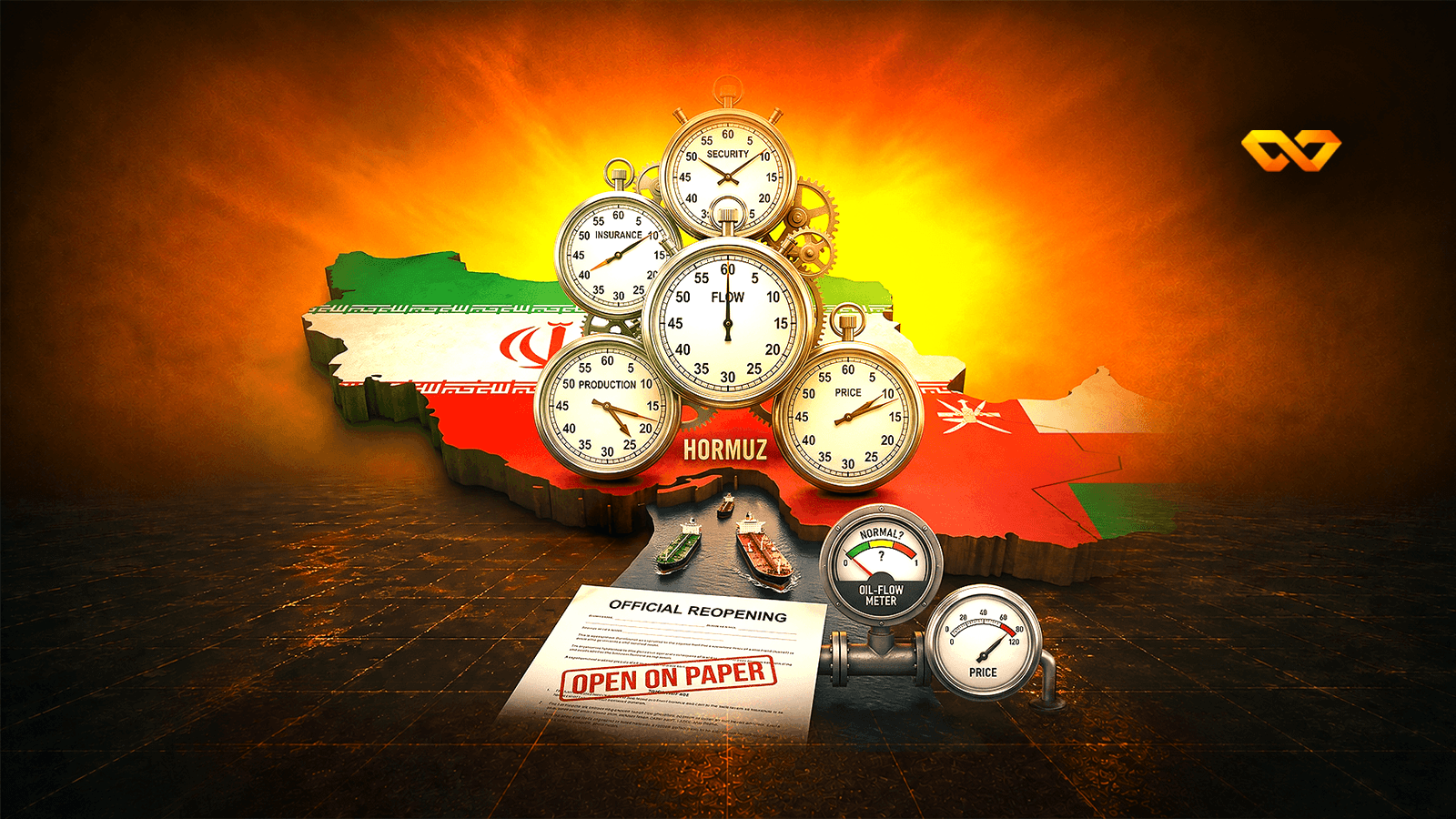
Why is a reopening announcement insufficient to judge the situation? Because security, insurance, flows, production and price are clocks running at different speeds — and only one says conditions are normal.
The Joint Maritime Information Center (JMIC) announced on 18 June that the Strait of Hormuz was “open”. But “reopening” is not a single event; it is five clocks operating at different speeds: the navigation announcement, then the security risk, then commercial insurance, then flows and production, then price. Just nineteen days after the announcement, the threat level had risen two steps on the Center’s own scale — from “moderate” on the day of reopening to “severe” on 7 July after three tanker attacks in one day.
The hard numbers say the same thing: the US Energy Information Administration (EIA) estimated average crude oil and petroleum liquids transit through the strait at 4.9 million barrels per day in Q2 of 2026, against 21.6 million in Q4 of 2025 — only 22.7% of the baseline, and a quarterly average rather than a daily reading in August. War-Risk Insurance rose from around 0.25% of vessel value before the war to a range of 3%–10%, and is repriced every 24 hours. Gulf exports reached 16.1 million barrels per day in June, according to the International Energy Agency (IEA) — a genuine recovery, but one that includes alternative routes, while production itself remains below its pre-war level by 11.4 million barrels per day. Price, meanwhile, swung through four opposing waves: −15.56% then +40.24% then −18.08% then +7.78%, with Brent closing at 88.91$ on 11 August — according to the EL7 database.
Verdict: the strait has been open to navigation since 18 June, but — by the measure of the five clocks — remains closed commercially. This aligns our reading with our published operations-room dossier, which classifies the situation as “closed — month six”: there is no contradiction between the two headings, only two different clocks. Normalisation is not measured by a political headline, but by convergence in security, insurance, flows, production and inventories — and the clocks have not yet aligned.
Readings as at 12 August 2026 • each clock’s source appears in its section below
This part of the paper is open to EL7 Pro members and to free members who use one of this month's free papers on it. The paper goes on to analyse the numbers, the causes and what they mean for investors, with tables, charts and sources.
This part of the paper is open to EL7 Pro members and to free members who use one of this month's free papers on it. The paper goes on to analyse the numbers, the causes and what they mean for investors, with tables, charts and sources.
This part of the paper is open to EL7 Pro members and to free members who use one of this month's free papers on it. The paper goes on to analyse the numbers, the causes and what they mean for investors, with tables, charts and sources.
A free account gives you 4 full research papers every month. Or subscribe to EL7 Pro for full access to more than 300 papers.
$700 per year · or $99 per month