
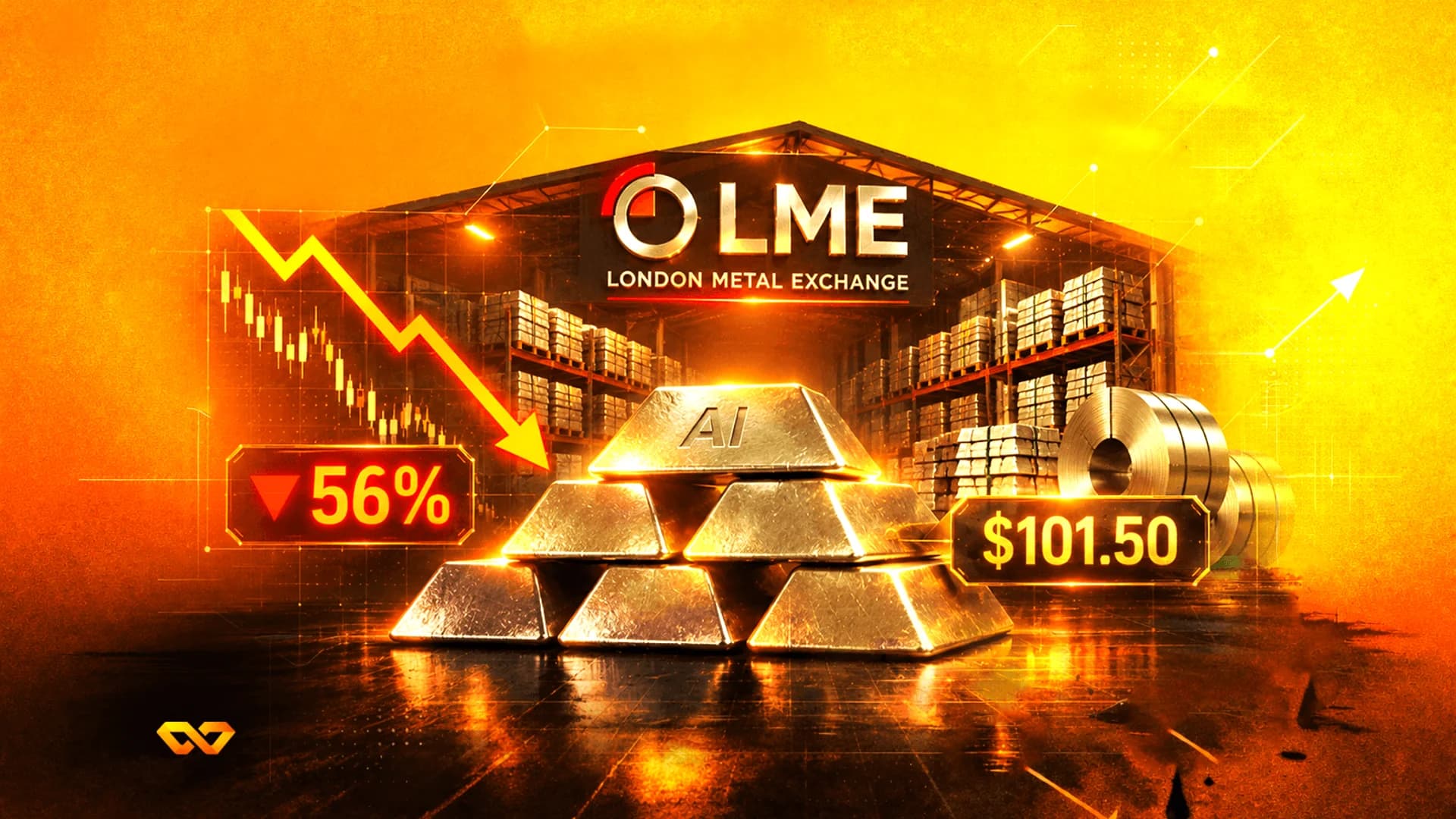
LME Aluminum Inventories Fall 56% as Spot Premium Reaches $101.50
Key Facts
LME aluminum inventories have fallen 56% since the start of 2026, reaching their lowest level since 1990, according to a Mining.com.au report published on November 10. The premium of the cash contract over the three-month contract reached as much as $101.50 per ton on the Monday before the report was published. The widening spread between the two prices reflects tight availability of metal for near-term delivery, as registered exchange stocks decline. Ewa Manthey, commodities strategist at ING, said, "The backwardation really reflects how tight the physical market is right now." She noted that few sources of metal can reach LME warehouses quickly.
Backwardation describes a market in which the cash price trades above the futures price, and it has come to the fore as inventories have fallen and the premium for near-term delivery has widened. The Mining.com.au report said exports by Gulf aluminum producers have become more costly, riskier and slower than before, despite the use of alternative routes to ease shipping disruptions. These conditions make it harder for metal to reach buyers and warehouses on time. The report added that some smelters in the region are still recovering from direct attacks on their facilities in the early stages of the war. These factors link pressure on Gulf supplies to tension in the spot market, without implying that all available volumes have disappeared.
Constraints are not limited to regional supplies; China’s aluminum production cap and trade barriers affecting the United States and Europe, along with Middle East disruptions, have limited the available surplus, the report said. In a broader context, the Associated Press, citing Fastmarkets estimates, said the Middle East typically produces about 9% of the world’s aluminum and that regional output is expected to fall 44% in 2026 compared with 2025. S&P Global also reported that global primary production fell 1% to 54.8 million tons between January and September, after regional disruptions cut Gulf Cooperation Council output by more than 1.4 million tons. These figures place the shortfall in Gulf supplies within a broader picture of declining global production. The arrival of metal at trading warehouses remains an important factor in determining the size of the surplus immediately available.
The Mining.com.au report, citing Bloomberg and exchange data, said four unidentified holders of long positions collectively account for at least 25% of open interest in November aluminum contracts. Those contracts are due to expire in the week after the report was published, putting the availability of metal for immediate delivery in traders’ focus. This comes as the premium of the cash contract over the three-month contract reached $101.50 per ton on Monday, according to the same report. In an earlier comparison, the cash-to-three-month spread widened to $61 per ton on November 4, from $20.50 a week earlier, according to Platts estimates cited in an S&P Global report. These readings show the near-term delivery premium widening in the preceding period, alongside falling inventories.
LME opening stocks fell to 228,750 tons on November 4, from 231,675 tons on October 29, while closing stocks in that day’s report fell by a further 275 tons to 228,475 tons. Inventories had reached 238,125 tons on October 14, their lowest level since 1990, according to a StoneX analyst cited by S&P Global. In the price market, LME aluminum peaked at $3,753 per ton in September, up 25% from the start of the year, before the index retreated to $3,080 per ton in October. EL7 daily data showed a close at $3,191.5 per ton on November 6. These levels put movements in premiums and inventories in the context of a market that has seen price volatility in recent months.
Estimates for the market’s coming balance differ. S&P Global Energy CERA forecast that global primary aluminum supply would fall 1 million tons short of demand in 2026, and that the deficit would narrow to 179,000 tons in 2027 unless supply growth pushed the market into surplus. By contrast, StoneX forecast a surplus of 1.15 million tons next year as capacity expands and smelters outside China return, while Emirates Global Aluminium said it expects to restore full production in the first quarter of 2027. The report said Indonesia is expected to increase aluminum production in the coming years, but the additional supply has not yet reached LME warehouses. Manthey said a wider backwardation may be needed to attract metal into exchange warehouses, and she sees greater downside risks for prices over the longer term. How quickly new supplies reach the market and warehouses remains a decisive factor in addressing the current tightness.