
Kospi Falls 3.5% After Intel Drops 28.6% on AI Concerns
Key Facts
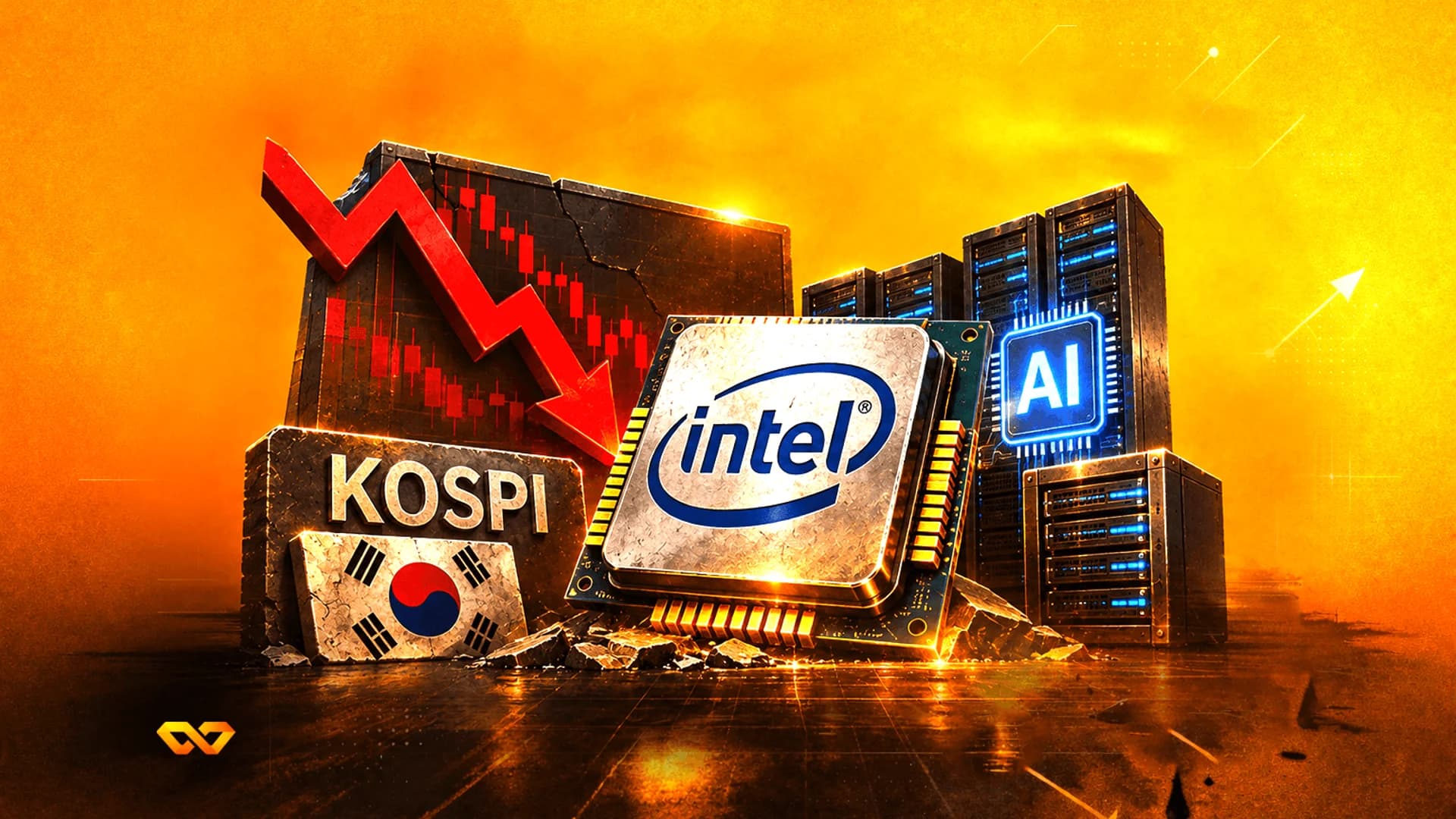
South Korea’s Kospi fell 3.5% in Friday’s session on October 30, 2026, as investor concerns about artificial intelligence weighed on the tech-heavy market. The decline followed a sell-off in U.S. technology stocks, led by a drop in Intel after it reported third-quarter results and issued fourth-quarter guidance. Intel shares fell 28.6%, their biggest decline since 1974, after its profit outlook came in below analysts’ estimates. The drop was not driven by a report of weak fourth-quarter revenue, as the quarter had not ended; it was tied to the company’s forward outlook. The Kospi closed at 5730.74 in the same session, according to EL7 data.
Intel forecast revenue of between 15 and 16 billion dollars in the fourth quarter of 2026 and non-GAAP earnings per share of 0.25 dollars. The guidance also included earnings per share of 0.10 dollars on a GAAP basis, according to the company’s results announcement published through Nasdaq. The outlook weighed on tech stocks, while Reuters cited weak demand for personal computers and the rising cost of the AI boom as factors that unsettled investors. Intel’s chief executive said demand for the company’s processors remained strong despite short-term headwinds in the PC market. He added that third-quarter results reflected improved execution and progress in expanding supply, placing weakness in the PC market alongside positive demand signals in the company’s business.
The sell-off spread beyond chip stocks, with the Nasdaq falling 2.9% in Friday’s session and the S&P 500 losing 1.8%. Portfolio manager Joe Tigay described the shift in AI trading, saying: "We are coming out of the hopes and dreams phase of AI trading and entering the show-me phase." The comment captures the market’s focus shifting to whether companies can turn heavy AI spending into tangible results. Intel shares closed at 65.76 dollars on October 30, according to EL7 data. SK hynix shares also fell from 164.70 dollars on October 28 to 149.21 dollars on October 30, according to the same data; these prices are in dollars as reported in the closing data, not local prices traded in won.
The sell-off comes as SK hynix’s third-quarter results showed strong growth in revenue and operating profit. Revenue reached 104.6155 trillion won, up 32% from the previous quarter, while operating profit reached 83.3338 trillion won, up 38%. The Associated Press reported that SK hynix and Samsung together control about two-thirds of the global memory market, placing the companies at the center of the demand cycle for memory chips used in AI systems. Samsung, in turn, reported quarterly revenue of 195.3 trillion won, up 14% from the second quarter, and operating profit of 107.4 trillion won. The results highlight the contrast between market concerns about the outlook for some technology companies and the performance of South Korea’s memory suppliers in the third quarter.
Both companies issued strong outlooks for demand for memory and AI-related chips. SK hynix said it expects HBM4 to surpass HBM3E in shipment volume and revenue during the fourth quarter of 2026 and to become its main product. The company also expects memory demand to continue exceeding supply through 2030. Samsung said it expects demand for AI chips to accelerate during 2027 and exceed supply as customers expand AI infrastructure. These forecasts set South Korean suppliers’ bets on continued growth in the memory market against concerns raised by Intel’s guidance and weakness in the PC market.