
Volkswagen posts €5.860 billion operating loss in third quarter
Key Facts
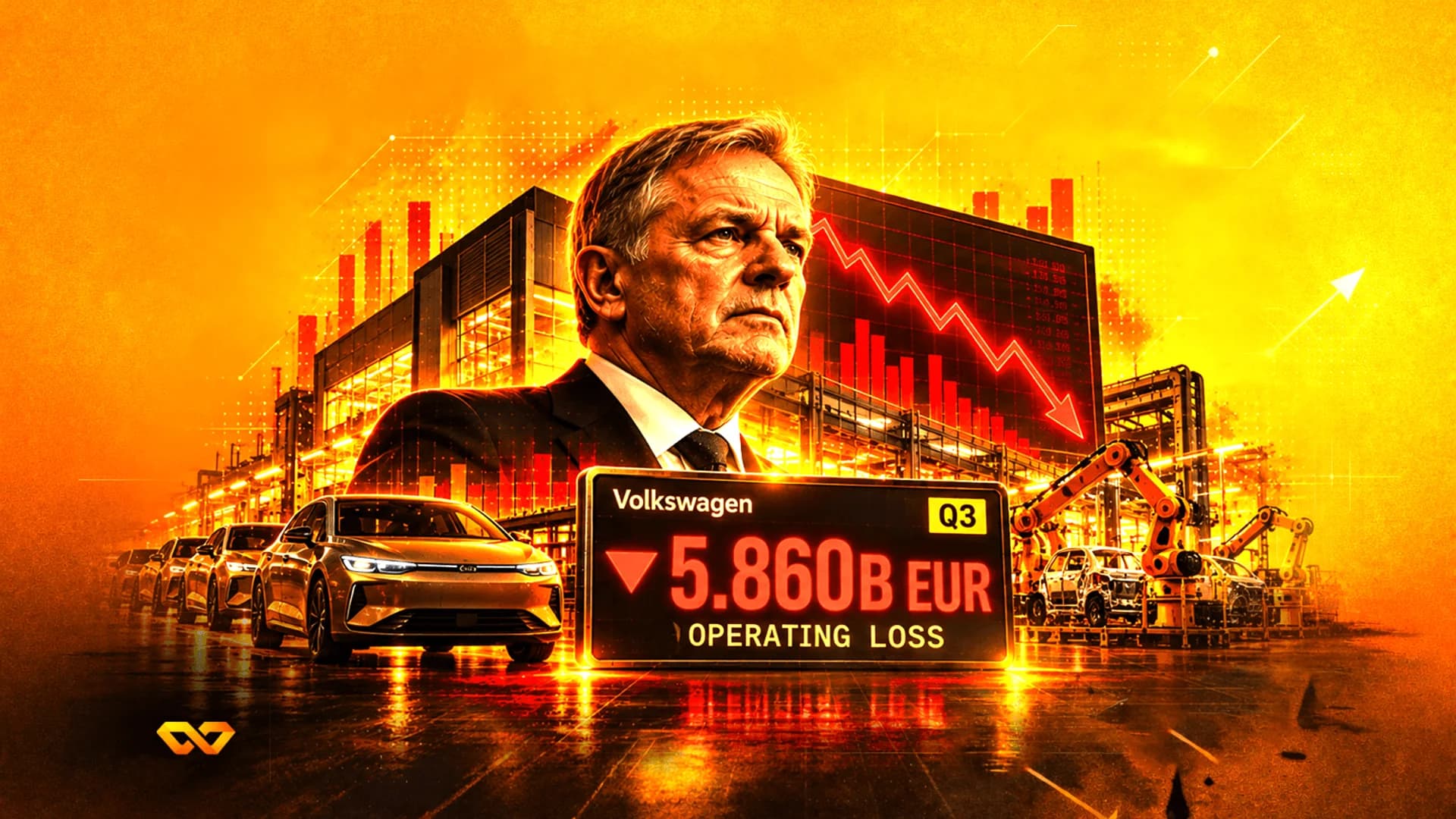
Volkswagen Group posted an operating loss of €5.860 billion in the third quarter of 2026, compared with a loss of €1.299 billion in the same period of 2025, while revenue fell 6.3% to €75.277 billion from €80.305 billion. The results showed mounting pressure on the group’s business, with revenue and operating performance declining during the quarter. Special items totaled €7.8 billion in the third quarter, part of a total of €8.7 billion in the first nine months. Chief Financial Officer Arno Antlitz said the group "cannot afford to lose any time and must move quickly and decisively." The quarterly loss comes as the company faces weakness in its main markets and works to cut costs and reshape its operations.
In the first nine months of 2026, revenue came to €233.378 billion, compared with €238.669 billion in the same period a year earlier. Operating profit fell to €71 million from €5.408 billion, bringing the result close to breakeven after the group posted operating profit of billions of euros a year earlier. Special items included a non-cash €6.4 billion write-down of Porsche goodwill, along with impairment adjustments of about €1 billion for assets at joint ventures in China. Most special items were concentrated in the third quarter, when their impact totaled €7.8 billion. These items show the scale of the accounting impact on the period’s results, while nine-month operating profit remained sharply lower than a year earlier.
Volkswagen customer deliveries fell 14.3% to 1.885 million vehicles in the third quarter, from 2.199 million a year earlier. In the first nine months, customer deliveries totaled 6.011 million vehicles, down 9.0% year on year. Vehicle sales totaled 5.880 million over the same period, down 10.6% from 2025. The group said weakness in China’s market environment, pricing pressure, competition and a higher share of lower-margin electric vehicles weighed on earnings. It added that U.S. tariffs were a burden and competition in Europe was intensifying. The decline in deliveries and sales comes amid a contraction in the Chinese market and growing competitive pressure that is limiting the company’s ability to improve returns.
By contrast, data for the Automotive division showed an improvement in cash flow during the period, with net cash flow of €4.4 billion in the first nine months, up 145% from the same period a year earlier. The division’s net liquidity stood at €33.0 billion on September 30. The figures offer an indication of the group’s ability to generate cash and retain a substantial liquidity base despite the sharp decline in operating profit. Volkswagen says its cost-cutting program totals about €31 billion and aims to simplify structures, reduce expenses and improve factory efficiency. The company is pursuing these measures to address costs as revenue and deliveries have fallen.
Orders for fully electric cars in Europe rose 39% in the first nine months, and these vehicles accounted for 40% of the European order book, the company said. The figure relates to customer orders, not delivered sales, at a time when the group recorded a decline in overall deliveries. Volkswagen also cut its 2026 outlook to revenue of around €315 billion and an operating return margin of up to 1%. The company expects Automotive division net cash flow of between €3 billion and €6 billion for the year. The outlook puts a low profit margin alongside expected cash flow as the company seeks to turn demand for electric models into stronger operating performance.
Volkswagen’s future plan includes adjusting its workforce by around 50,000 jobs across the group, while Chief Executive Oliver Blume said about 37,000 signed exit agreements were already in place. The plan also aims to reduce the model range by around 50% by 2035. The company says European production capacity exceeds demand by around 500,000 units and is preparing a proposal to restructure European production by the end of June 2027. Negotiations between Volkswagen and IG Metall are due to begin in Emden on November 24, 2026, and continue in Zwickau on December 15. The talks are part of the company’s effort to reduce labor costs and reorganize production, with employees and the group awaiting their outcome.
Upcoming dates include the UBS European Conference in London on November 11, 2026, followed by Volkswagen’s annual media and investor conference on March 9, 2027. The company is scheduled to provide an update on its business to the media and investors at the annual conference. Before then, labor negotiations in Germany will continue through November and December, while the group prepares a proposal for the structure of European production by the end of June 2027. The 2026 outlook, which puts revenue at around €315 billion and the operating margin at up to 1%, remains a benchmark for measuring the group’s performance this year. Volkswagen is seeking to address falling profits and deliveries through its cost-cutting and restructuring program.