
Alberta votes on October 19 on starting legal process for separation from Canada
Key Facts
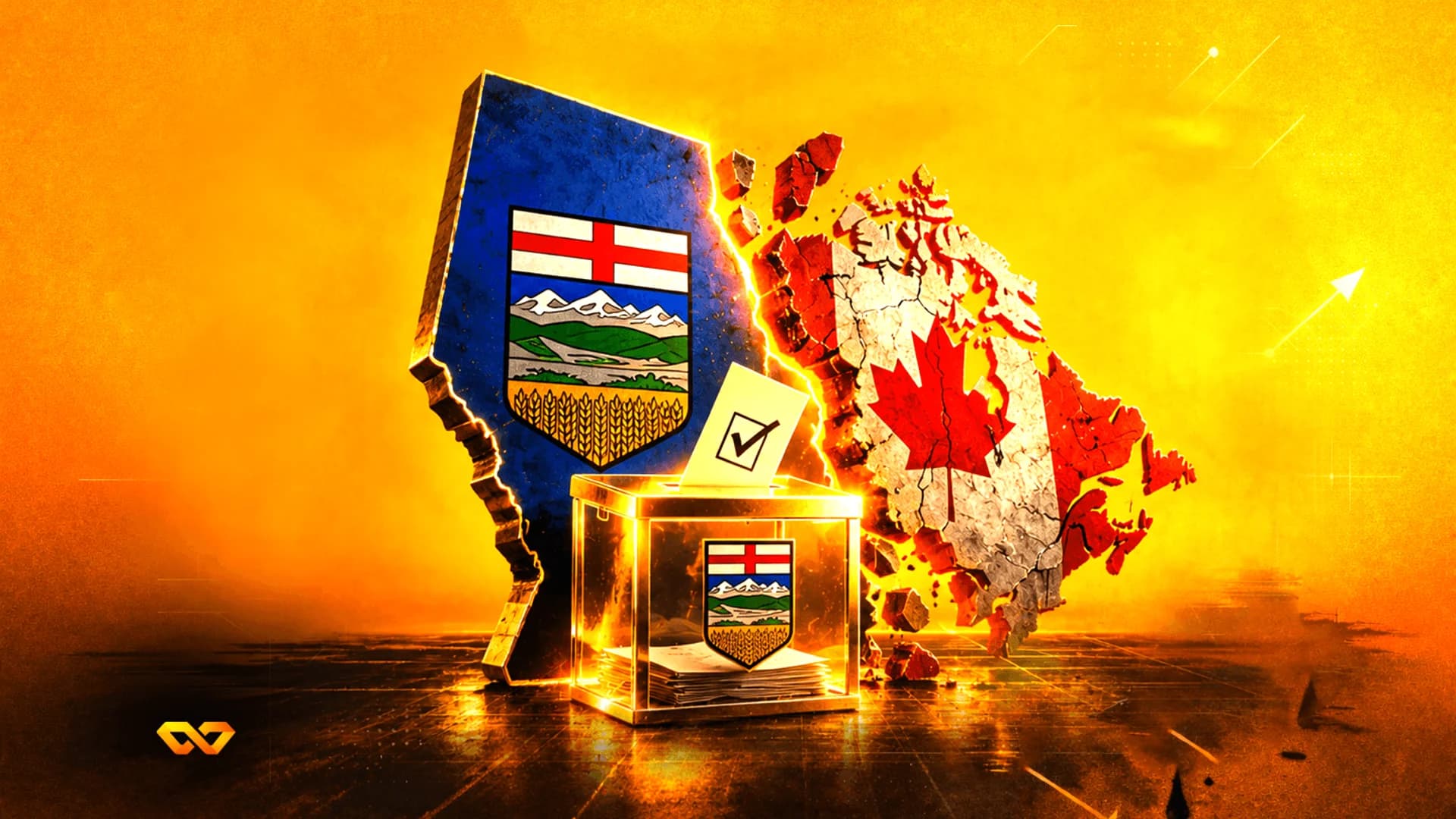
Voters in the Canadian province of Alberta head to the main ballot on Monday, October 19, in a non-binding referendum on starting the legal process toward a subsequent vote on separation, according to the provincial election authority. The question asks voters to choose between Alberta remaining a Canadian province and beginning the legal procedures required to hold a binding referendum on leaving Canada. The current vote therefore provides no direct mandate to declare independence, but concerns moving toward a process that would allow separation to be put to a vote again. Advance voting preceded the main polling date, beginning on Tuesday, October 13, and ending on Saturday, October 17, 2026, according to a statement from the election authority. The vote coincides with energy cooperation between the Canadian and Alberta governments aimed at expanding oil exports to Asian markets.
An Ipsos poll published on June 5, 2026, showed that 18% of respondents would vote for separation in a hypothetical binding referendum. The poll compared that figure with support of 28% in January 2026, a decline of 10 percentage points between the surveys. The Ipsos question concerned leaving Canada itself, while the current ballot concerns beginning the procedures required for a subsequent binding vote. Alberta Premier Danielle Smith, for her part, said in an address to provincial residents: "I support Alberta remaining within Canada." Her government also announced that it would appeal the court ruling concerning the separation petition to the provincial Court of Appeal.
On the financial front, an independent University of Calgary report announced by the Alberta government estimated the cost of establishing a new country at between C$50 billion and C$170 billion. The estimate covers the first 5 years after separation, under the report's scenarios for the transition to an independent country. In a difficult-negotiations scenario, Alberta's government could face a persistent annual deficit exceeding C$30 billion, according to the independent report. That deficit remains possible under that scenario despite tax increases, according to the provincial government's presentation of the study's findings. A potential economic recovery under a smooth-separation scenario depends on specific conditions, including oil prices remaining high.
Alongside the separation issue, the federal and provincial governments announced an energy agreement aimed at more than doubling oil exports to Asian markets. According to an Alberta government statement, the agreement includes addressing investment uncertainty and reducing emissions, alongside the goal of expanding oil exports. Smith said in her address to provincial residents that the federal oil and gas production cap "has been scrapped." Alberta aims to produce 6 million barrels of oil a day by 2030, according to the federal-provincial energy partnership page published by the provincial government. Under the same partnership, the target rises to 8 million barrels a day by 2035.
Oil cooperation projects between Ottawa and Alberta include the "Pacific Link" pipeline, which was designated a project of national interest on October 1, 2026. The government project database expects the pipeline to carry more than a million barrels of oil a day to Canada's west coast once built. According to the Alberta government's project page, construction could begin as early as September 1, 2027, the earliest possible start date. Reaching that stage depends on completing consultations with Indigenous peoples, under the conditions set by the provincial government for the project. Starting construction also requires the necessary approvals and permits, alongside meeting the consultation requirement.
The constitutional path to separation is governed by Canada's Clarity Act, which requires an amendment to Canada's Constitution for any province to leave the federation. The law provides for separation negotiations involving, at a minimum, the Canadian government and the governments of all provinces. This process accompanies the subsequent binding referendum for which the current vote concerns starting the necessary legal procedures. Immediately after polls close, Elections Alberta requires the unofficial count to be completed within 48 hours of voting ending. The authority set October 29 at 10:00 a.m. for the official declaration of results.